Dr Sheppard's manuscript
The Murder of Roger AckroydDr. Sheppard’s manuscript is the written record of the Ackroyd investigation—and, in retrospect, the mechanism by which its narrator tries to hide that he is the murderer. Its chapters preserve observations from the case while carefully limiting what they disclose; when Hercule Poirot reads the accumulated pages, their omissions become evidence. In the manuscript’s final turn, a narrative presented as a record of events becomes an explicit confession, then a document Sheppard intends to send to Poirot before taking his own life.
Creation and Form
Sheppard says he began writing because he had read Captain Hastings’s narratives and wanted to try something similar. The case seemed a unique opportunity, perhaps the only time he would be involved in an affair of that kind. He describes himself as becoming increasingly embarrassed and incoherent as he explains the project to Poirot; the self-consciousness matters, because this account is never merely a neutral transcript of an investigation. It is composed by a participant who knows more than he tells.
The manuscript is an untidy pile, but Sheppard has divided it into chapters with possible future publication in mind. The night before showing it to Poirot, he brings it up to date with an account of Miss Russell’s visit, leaving Poirot with twenty chapters to read. Its developing form gives the impression of a record kept alongside the investigation, yet Sheppard’s attention to presentation already complicates that impression: he is arranging the case as a narrative while withholding the facts that would reveal his own part in it.
Poirot Reads the Record
Sheppard hands the pages to Poirot after admitting that he may have been personal at times. Poirot anticipates that he has been depicted as comic or ridiculous, but says he does not mind; what excites him instead is the prospect that Sheppard has written down his impressions as the case unfolded. Poirot calls the manuscript magnificent and asks to see it immediately. His eagerness turns Sheppard’s private literary project into an investigative object: the detective can compare what the account says with what its author has chosen not to say.
While Sheppard is away on a distant case, Poirot continues reading in his workshop after supping with Caroline. On returning, Sheppard learns that Poirot has finished the manuscript. Later, Poirot identifies its governing defect with precision: it is strictly truthful as far as it goes, but it does not go very far. That distinction is the document’s central paradox. The apparent reliability of its statements depends on an incompleteness that directs suspicion elsewhere.
Omissions and Evidence
Poirot reads the account against the physical clues of the murder. In the manuscript, Sheppard has drawn a plan of the study. Poirot uses that plan to reconsider the chair Parker saw pulled away from the wall: in the position indicated, it stood directly between the door and the window. The chair’s placement initially suggests concealment of something near the window, but it obscured little of the window itself. What it completely hid was the table of books and magazines in front of it. The diagram therefore preserves a clue that the prose’s omissions cannot neutralize; Poirot’s reading of the plan helps him form his first shadowy suspicion of the truth.
The manuscript’s more decisive blank concerns the interval between the arrival of the letters at twenty minutes to nine and Sheppard’s departure just before ten minutes to nine. He reproduces the sequence in a neat passage, ending with himself pausing at the door and wondering whether anything has been left undone. Each stated detail is true, he later insists. But he points out that placing a row of stars after the sentence about the letters would have left a gap of ten minutes, inviting questions about what happened while the account fell silent. The missing time is not an accidental lapse: its absence protects the concealed action while allowing the surrounding sentences to retain their literal truth.
Concealment and Disclosure
The manuscript also withholds Sheppard’s knowledge of Ralph Paton’s situation. Poirot recalls that, at a small gathering around a table, he accused all six people present of concealing something; four disclosed their secrets, while Sheppard did not. Poirot had suspected that Sheppard went to the Three Boars hoping to find Ralph, failed to find him there, and might instead have met him in the street on the way home. Sheppard then admits that he visited Ralph that afternoon. Ralph initially refused to confide in him, but eventually told him about his marriage and his financial difficulties.
Sheppard explains that, as soon as the murder was discovered, he realized suspicion would attach to Ralph or to the woman Ralph loved once the facts became known. He told Ralph the situation plainly that night. The possibility that Ralph might have to give evidence incriminating his wife led Ralph to resolve to avoid that outcome at all costs. The manuscript has concealed not only what Sheppard himself did but also the extent of his knowledge of Ralph’s marriage and the circumstances behind Ralph’s disappearance.
Poirot’s account of the evidence brings that concealment into the open: the patient he identified under another name was Captain Paton, whom he was allowed to remove after the necessary formalities. Ralph had arrived at Sheppard’s house in the early hours of the previous morning. Sheppard recognizes that Poirot’s reference to the reticence of the manuscript applies to this hidden story as much as to the murder. Ralph, in turn, says Sheppard stood by him through thick and thin, though he now understands that hiding from the truth was not the best course and that he should have come forward. Ralph had known nothing of the public developments because there were no newspapers in the home where he was concealed.
Confession and Intended End
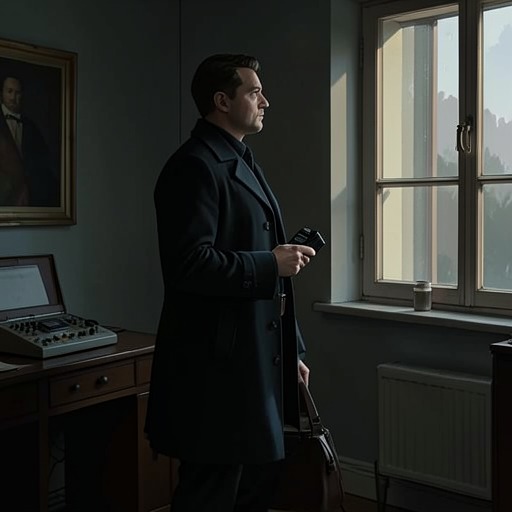
At the manuscript’s conclusion, Sheppard explains that after hearing of Mrs. Ferrars’s death he became convinced she had told Roger Ackroyd everything before she died. When Ackroyd seemed agitated, Sheppard believed he might know the truth but be unable to accept it, and might give Sheppard the chance to refute it. Sheppard therefore went home and took precautions. The Dictaphone Ackroyd had given him two days earlier for adjustment had gone wrong; Sheppard persuaded Ackroyd to let him work on it rather than send it back, made the alteration he wanted, and carried it to the house in his bag that evening. The final account thus joins the manuscript’s method of deception to the murder’s practical preparation: in each, selective truth creates a false impression.
Sheppard says he is pleased with himself as a writer, and uses the passage about the letters to demonstrate the neatness of his construction. His confidence in the prose is inseparable from its incriminating failure: by drawing attention to the unmarked ten-minute interval, he shows the reader exactly how his narrative concealed what happened. The account does not simply record a crime. It explains how its author fashioned a record that could be accurate sentence by sentence and misleading as a whole.
Once he has finished writing, Sheppard intends to place the entire manuscript in an envelope addressed to Poirot. He considers taking Veronal, describing the choice as a kind of poetic justice, but disclaims responsibility for Mrs. Ferrars’s death and says he feels no pity for her or for himself. His closing pages therefore transform the case narrative into a final, deliberately directed communication. The detective who saw through the manuscript’s reticence is to receive the full account, while Caroline is to remain unaware of the truth. The document’s last purpose is not publication after all, but disclosure to Poirot and the record of Sheppard’s intended suicide.